

A number of years ago, when I was in a very difficult place with my mental health, I used to sit on the edge of my bed, taking my antidepressants whilst crying.
I hated taking them.
I felt like a complete failure. I thought I should have been coping better. I had good people around me. I had resources. I had my faith. Why couldn’t I just get over the things that had happened in my life?
At the time, I drew an illustration in my journal to help me process what I was feeling. In the picture, I’m sitting on my bed, looking utterly defeated, saying:
“I hate these. But I know I need them right now.”
Cognitively, I knew taking the medication was probably a good idea. I knew I needed help. But emotionally, the act of actually taking it felt painfully difficult.
When I drew that illustration, I would never have imagined sharing it publicly one day. Back then, I barely even wanted to admit to myself that I was struggling with my mental health, let alone share my personal journal illustrations online.
But here in the UK, it’s Mental Health Awareness Week. And this year’s theme is action. Not just awareness. Action.
As I’ve reflected on that this week, I’ve realised something important.
Taking those antidepressants was action.
Quiet action.
Private action.
Reluctant action.
But action all the same.
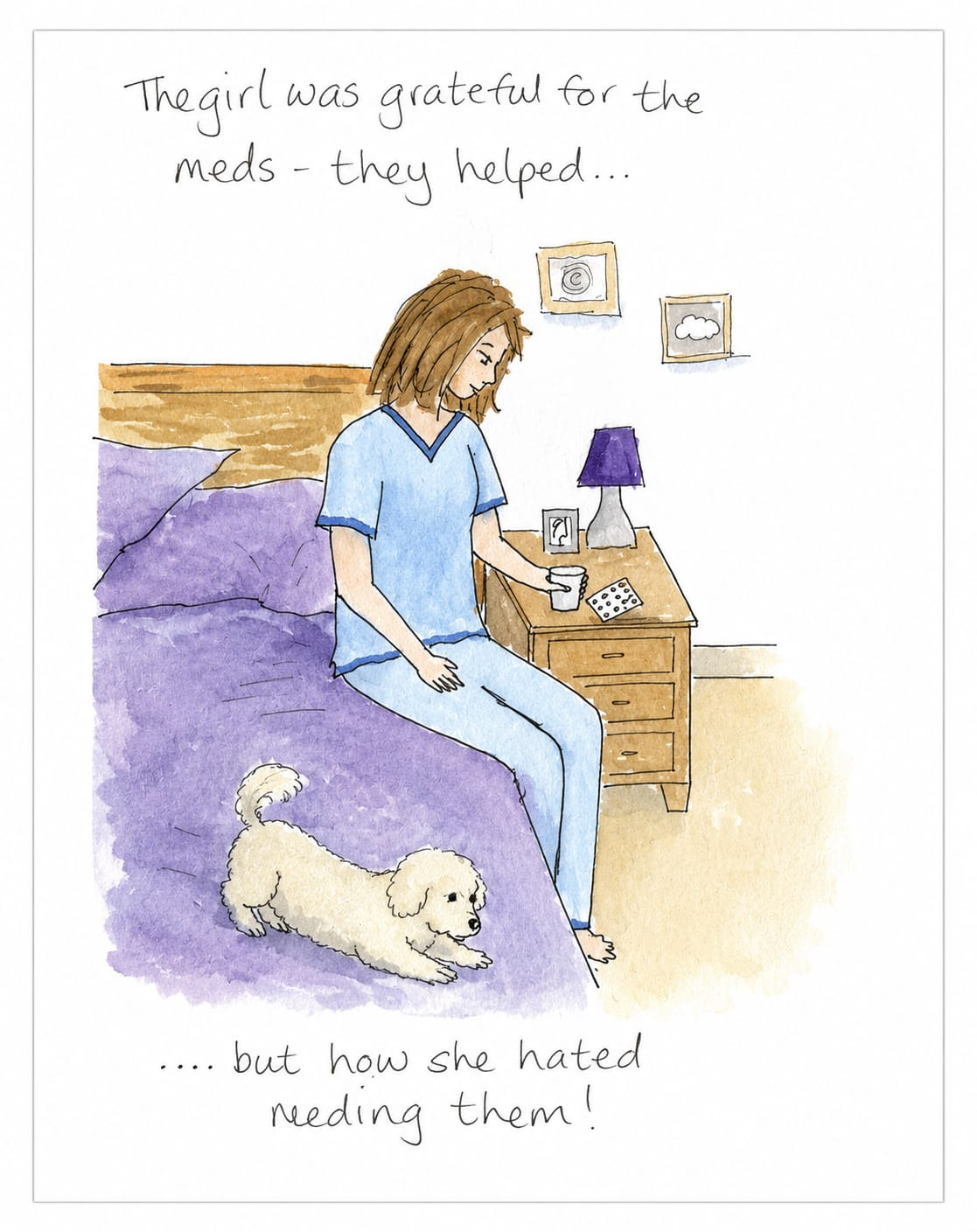
Looking back now, I can see that it was actually courageous, even though I didn’t feel brave at all at the time.
My mindset, my inner critic, and perhaps parts of my upbringing were all telling me:
Don’t do this. You should be stronger. You shouldn’t need this help.
I felt shame for struggling. Shame for needing medication. Shame for not coping.
And honestly, I feel sad now that so many of us carry those same voices around in our heads. Voices telling us we are failures if we struggle mentally or emotionally.
But mental health difficulties are not moral failures. And needing support is not weakness.
Over the last few days, I’ve found myself reflecting on some of the actions, both seen and unseen, that have genuinely helped me care for my mental health.
Yesterday evening, I went to a lovely social clay-building session. It was my first time there. There were about twelve people, and the warm welcome was given by a lovely lady leading the group.
I went because I love being creative and I love clay. But truthfully, I also went because I needed relief.
I needed breathing space. I needed to do something gentle and grounding.
I slab-built a mug and made a pinch pot. We chatted about all sorts of ordinary things. Most of the people there knew absolutely nothing about my history or the things I’ve walked through recently. They were simply kind, warm people, sharing an evening of creativity together.
Driving home afterwards, I realised again that actions for our mental health do not always need a label attached to them.
Sometimes we imagine taking action means announcing something publicly, making a dramatic change, posting an inspirational quote online, or turning healing into something shiny and visible.
But often, the actions that keep us going are much quieter than that.
Sometimes they look like joining a running club.
Going to a pub quiz.
Attending a poetry evening at the library.
Joining a book club.
Going to a pottery evening.
Taking a walk.
Making time for connection.
Sitting in the car alone with a coffee after doing the shopping.
Listening to music or an audiobook.
Or simply building extra breathing space into the day.
Nobody else has to know why you’re doing these things.
Another thing I’ve had to learn is that sometimes action looks like saying no.
Not overcommitting.
Not trying to prove I’m okay by pushing myself beyond my limits.
Not constantly performing strength.
Sometimes rest is the action we most need.
Another thing that has helped me is honesty and connection. Making time with trusted friends, where I can say how things really are instead of pretending.
And another thing has been movement.
My therapist has often said to me at the end of a session, especially if I’m distressed or emotionally reactive:
“Andrea, I think you need to move your body. What are you going to do?”
And she’s usually right.
Sometimes I’ve gone for a long walk. Sometimes I’ve gone puddle stomping. Sometimes I’ve kicked around autumn leaves like a child.
Because we’re not just minds carrying thoughts around. We are bodies too. And sometimes movement helps us process what words cannot.
I think for a long time I misunderstood what courage looked like.
I thought bravery meant coping quietly, keeping going, needing nothing, holding everything together.
Now, I think courage often looks much softer than that.
Sometimes courage looks like:
Taking the medication.
Cancelling the plans.
Asking for help.
Resting.
Telling the truth.
Crying in front of someone safe.
Admitting that you’re struggling.
Doing one small, gentle thing that helps you stay afloat.
Action doesn’t always look shiny or inspiring or Instagrammable!
Sometimes it simply looks like caring for yourself in small, quiet ways that nobody else sees.
So perhaps this Mental Health Awareness Week, alongside raising awareness, we might also gently ask ourselves:
What actions help us stay well?
And maybe we can also begin refusing the shame that so often surrounds mental health struggles.
Because courage is not about never struggling.
Courage is responding to our struggles with honesty, gentleness, support, and care.