

For years, my story felt like a tangled ball of wool.
It took a circle of women to help me find the thread.
I had thought healing was something you did quietly.
In a therapy room.
With the door closed.
One brave conversation at a time.
But what I didn’t expect was that some of the deepest shifts in my healing would happen sitting in a small Zoom circle with a group of women I had only just met.
Recently, I’ve been reading Desire: The Longings Inside Us and the New Science of How We Love, Heal, and Grow by Jay Stringer. It’s an extraordinary book — perhaps one of the most impactful I’ve ever read.
One line in particular has stayed with me:
“Community is the place where shame-based belief systems go to die.”
I’m beginning to understand exactly what he means.
A small piece of neuroscience
Here’s a slightly geeky neuroscience moment.
Trauma has a strange way of affecting language. A region of the brain responsible for speech — called Broca’s area — can go offline when we revisit painful memories.
Which means that sometimes the hardest part of healing isn’t the emotions.
It’s finding the words.
But something remarkable happens in community.
We begin to borrow language from one another.
Someone tells their story, and suddenly something clicks:
Oh… that’s it.
That’s what I’ve been feeling.
That’s the experience I didn’t know how to describe.
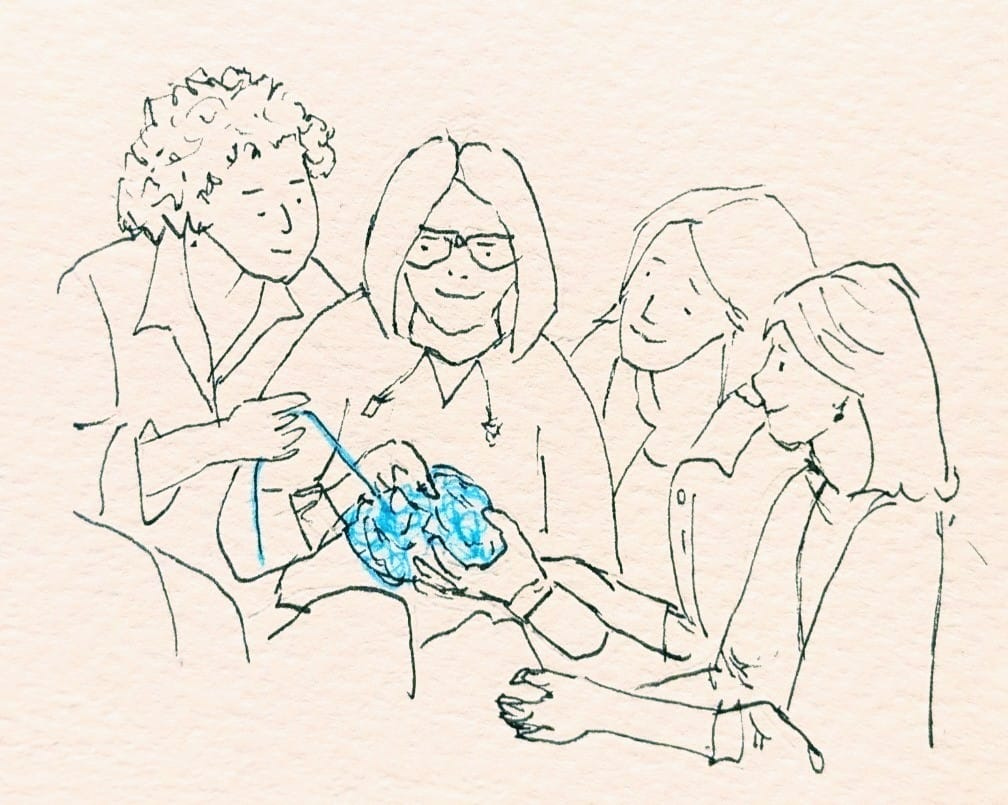
Sometimes it feels like someone has simply pointed to the right thread in a very tangled ball of wool.
My resistance to group work
I’ll happily admit that I resisted this idea for a long time.
For nearly five years, I’ve been doing deep individual work in therapy. Several times, my therapist gently suggested group work.
Every single time, I dug my heels in.
I had plenty of convincing reasons:
Other people’s stories will overwhelm me.
I don’t want to wash my dirty laundry in public.
It probably won’t help anyway.
In hindsight, I think the real reason was much simpler.
Shame hates an audience.
That’s why I resisted group work for so long.
The unexpected breakthrough
At the beginning of 2026, I finally did something that surprised even me.
I joined a group-based coaching programme.
I was nervous. Honestly, I felt I had reached a point where I had little choice but to try something different.
And something unexpected happened.
As I slowly began sharing pieces of my story, I wasn’t met with judgment.
I was met with kindness.
Women I barely knew looked at me with compassion and said things like:
“You’re doing amazingly well.”
And as I reflected on that, I realised something quite confronting.
I had been telling my own story through an incredibly harsh lens.
In my version of events, I was weak. Failing. Not doing enough.
But other people saw something very different.
Community held up a mirror.
But not the kind of distorted mirror I’d been using on myself — the sort you find in a hall of mirrors that bends everything out of shape.
Instead, it reflected something clearer. Kinder. Truer.
When shame begins to loosen
Brené Brown famously says:
“Shame cannot survive being spoken and met with empathy.”
She also says that if you put shame in a petri dish, it needs three things to grow exponentially:
secrecy
silence
judgement
What I discovered was that this group quietly dismantled all three.
Psychiatrist Curt Thompson puts it this way:
“Shame dies when stories are told in safe places.”
And I think I actually felt that happening.
I felt my shame beginning to lose its grip.
The moment everything shifted
It was actually in this group that I had the realisation that led to my slightly ridiculous little cartoon drawing of me leaping over fences to rescue everybody else.
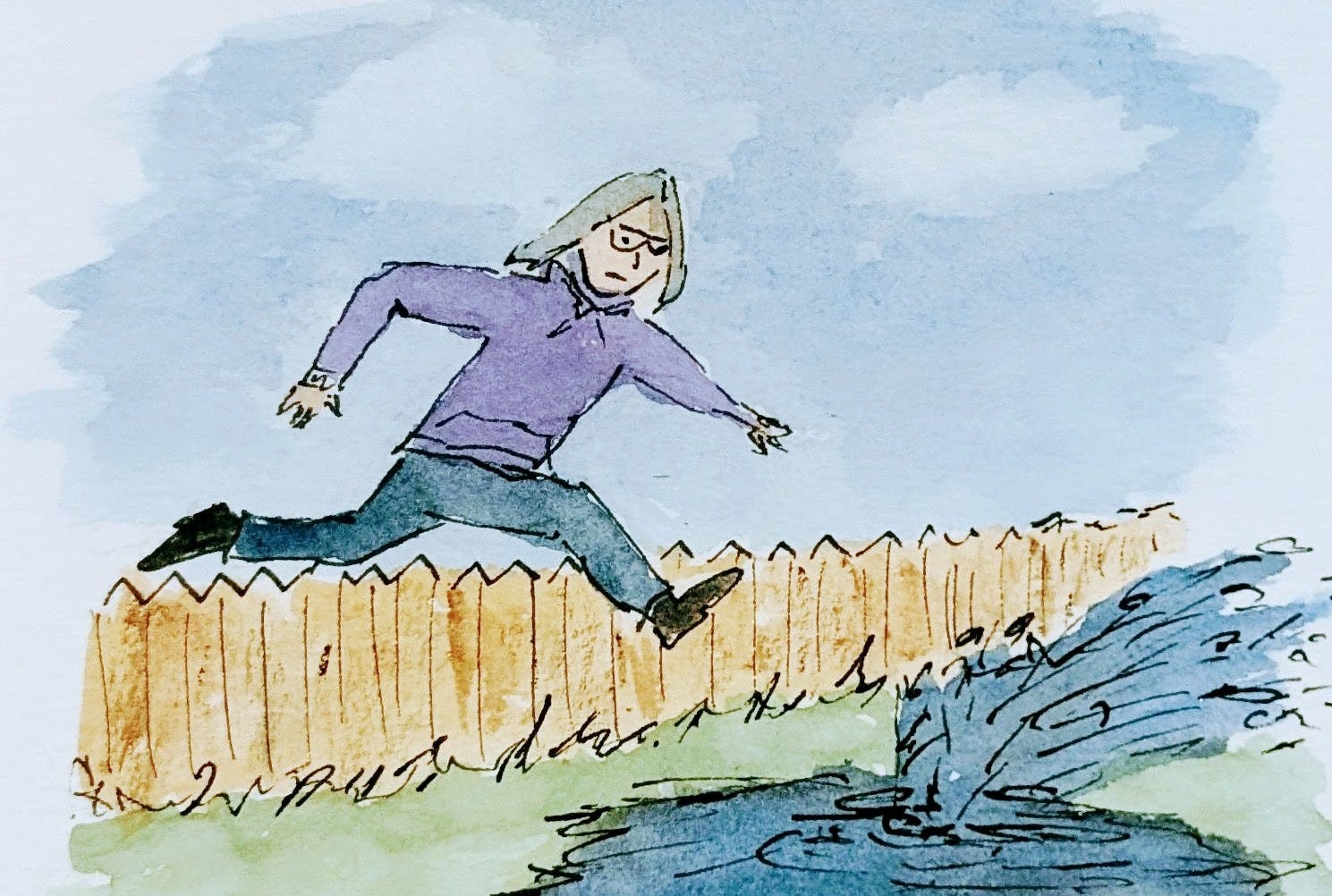
I realised I had essentially been running an unofficial neighbourhood rescue service.
Available 24 hours a day.
Seven days a week.
Just not available for myself.
But something shifted as I listened to these other women and watched the kindness with which they spoke to themselves and to each other.
Sometimes someone would say something about their experience and suddenly a piece of my own story would make sense.
It felt as if someone had quietly found the end of a thread in the tangled ball I’d been holding for years.
Once the end appeared, the knot didn’t disappear instantly.
But it began to loosen.
And slowly I realised something that seems obvious now but had somehow never occurred to me before.
I was allowed to rescue myself too.
I was allowed to have boundaries.
A new kind of desire
Jay Stringer writes that when we begin to understand our trauma, our desires start to change.
Instead of wanting to numb or escape, we begin to long for deeper connection.
That feels true for me.
I’m discovering that healing doesn’t always arrive through dramatic breakthroughs, clever insights, or heroic personal effort.
Sometimes it happens in very small moments.
Moments when someone simply says:
“That sounds really hard.”
A different understanding of healing
For years, I thought healing meant being able to understand my story perfectly.
To analyse it.
Explain it.
Find exactly the right words.
But now I’m beginning to think it might be something simpler.
Perhaps healing is just this:
Telling our stories in spaces where compassion lives.
Because in the presence of kindness, something remarkable happens.
The story itself may not change.
But the way we see ourselves inside it does.
If you’re carrying a story that feels tangled or heavy, perhaps a gentle question might be:
Where are the spaces in your life where compassion lives?
Healing doesn’t always happen alone.
Sometimes it begins when someone sits beside us and helps us gently loosen the knot.
Thank you for sharing so beautifully and honestly. Just after reading this, I listened to today's BBC Radio 4's Sideways episode which talked about community, compassion, forgiveness and even mentioned a tangled ball of wool! Maybe Someone's trying to tell me something?!
https://www.bbc.co.uk/sounds/play/m002snhy
Such a lot to think about. Thankyou again for that bravery in sharing as it helps others. Have a good rest of the week