

Last week I confessed to something slightly ridiculous.
Me: a grey-haired woman in pyjamas, upstairs, energetically thumping a blow-up punch bag.
It turns out quite a few of you related to that.
Several people fed back some version of:
“Ah… so the body needs somewhere for the ‘grr’ to go.”
That got me thinking.
Because once I’d finished laughing at the absurdity of it, the curious part of my brain woke up.
What was actually happening in the body when that release happened?
Why did ten minutes of slightly undignified punching leave me calmer, steadier, and much more at home in my own skin?
So, being the geek that I am, I went down a small neuroscience rabbit hole.
And what I discovered is surprisingly reassuring.
Anger and stress aren’t just emotional experiences.
They are biological processes moving through a living body.
The Stress Cycle
When something stressful happens, the brain activates the fight-or-flight response.
Signals from the brain tell the adrenal glands to release stress chemicals into the bloodstream.
These include:
Adrenaline (epinephrine)
This prepares the body for immediate action.
Heart rate rises.
Breathing speeds up.
Muscles tense.
Noradrenaline (norepinephrine)
This sharpens alertness and attention.
It’s the chemical that makes you feel wired, watchful, ready to react.
Cortisol
This is the longer-lasting stress hormone.
It mobilises energy by increasing glucose in the bloodstream and keeping the body on alert.
The neuroscientist Robert Sapolsky puts it simply:
“Stress-related diseases emerge when the stress response is activated too often or not shut off properly.”
In other words, stress itself isn’t the problem.
The problem is when the body never completes the stress cycle.
The writers Emily Nagoski and Amelia Nagoski explain this beautifully in their book
Burnout: The Secret to Unlocking the Stress Cycle.
Their key insight is simple:
“Just because the stressor is gone doesn’t mean the stress cycle is complete.”
The chemicals remain in the body until something signals to the nervous system that the danger has passed.
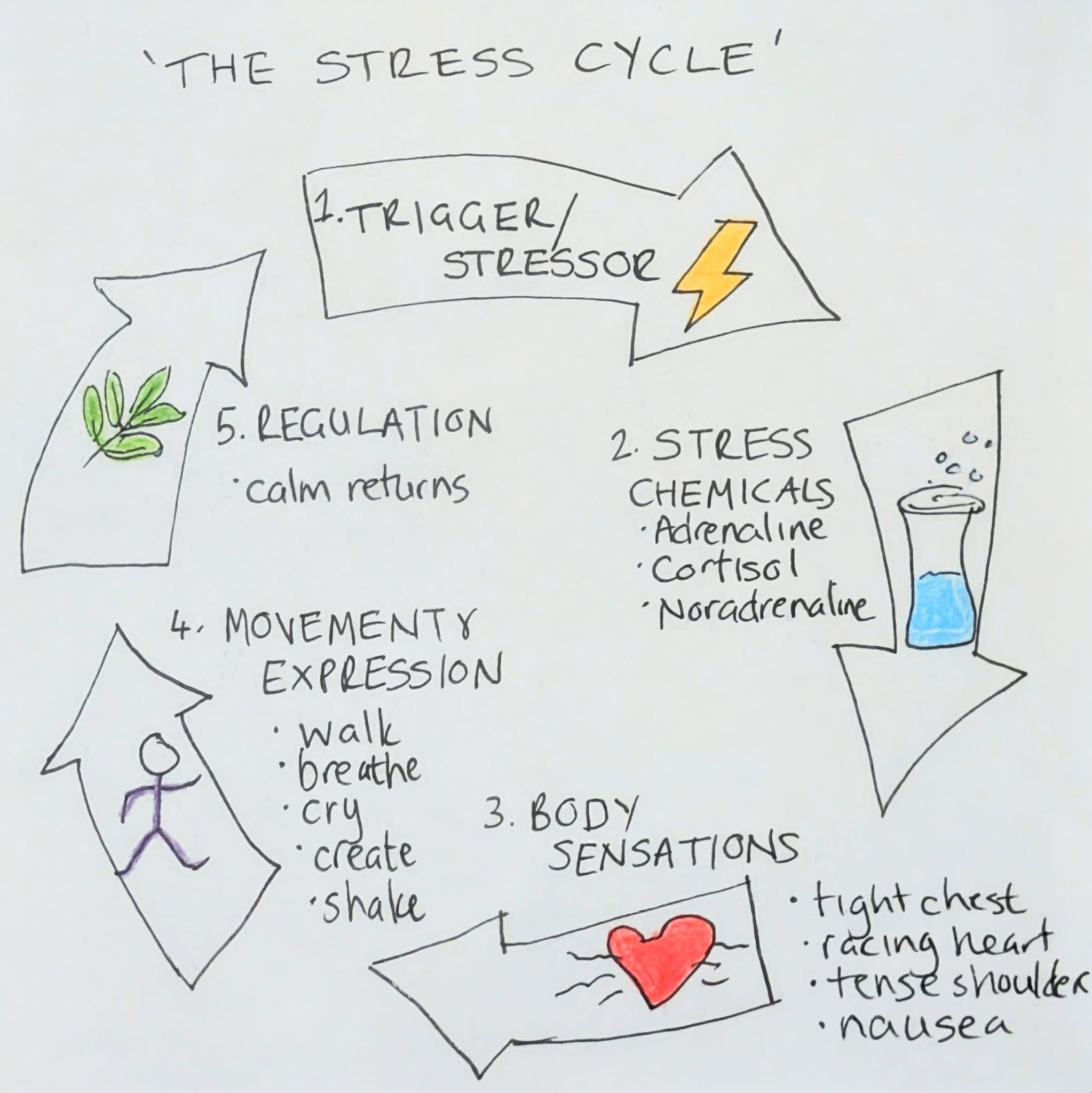
Three Things I Learned About Stress in the Body
Looking at the science, three things stood out to me.
1. Stress is physical before it is psychological
We often think of stress as something happening in our thoughts.
But the body experiences stress chemically and physically.
Adrenaline changes heart rate.
Cortisol changes energy levels.
Muscles prepare for movement.
Which means stress is not just something to think through.
It is something the body must move through.
2. The body expects action
The stress response enables survival.
If our ancestors encountered danger, they ran, fought, or escaped.
Movement completed the cycle.
But modern stress is different.
Emails.
Conflict.
Systemic failures.
Relational betrayals.
Low-level pressures that linger for months or years.
There is no lion to chase.
So the body releases the energy — but we sit still.
And the stress chemicals linger.
Which means that what I was doing with the punch bag last week wasn’t irrational after all.
It was simply giving my body a way to finish the stress cycle.
3. The nervous system calms when the body feels safe again
The nervous system has two main modes.
One prepares us for danger.
The other restores calm.
The neuroscientist Stephen Porges describes how the body settles when it receives signals of safety.
Those signals can be surprisingly simple.
Movement.
Slow breathing.
Crying or laughter.
Creative expression.
Connection with other people.
All of these help the body recognise that the threat has passed.
Letting the Body Finish the Story
The trauma researcher Peter Levine once wrote:
“Trauma is not in the event itself but in the nervous system.”
Our bodies are designed to complete cycles.
To mobilise energy.
To move.
To release.
To settle again.
Which perhaps shouldn’t surprise us.
As human beings, we are whole multifaceted people — body, mind and spirit — so it makes sense that healing needs to happen in all of our parts.
But when those cycles are interrupted, the energy stays circulating inside us.
Which is why completing the stress cycle might look surprisingly ordinary.
A brisk walk.
A game of badminton.
A good cry.
Singing loudly in the car.
Drawing or writing.
Or yes — occasionally punching an inflatable cylinder in your pyjamas.
What I’m Slowly Learning
What I’m slowly realising is that emotions aren’t problems to be solved.
They are signals moving through a body designed for movement, expression, and connection.
Sometimes wisdom looks like reflection and prayer.
And sometimes wisdom looks like helping the body do what it was designed to do.
Move.
Breathe.
Release.
Gradually, the chemistry changes.
The nervous system settles.
And the body remembers that it is safe again.
Sometimes healing doesn’t begin with understanding.
Sometimes it begins with letting the body move.
When stress or anger shows up in your body, where do you feel it first?
And what helps your body settle again?
Walking.
Gardening.
Crying.
Music.
Movement.
Or perhaps — like me — something slightly ridiculous involving pyjamas and a punch bag.
Sometimes we learn the most helpful things from each other. I’d love to hear from you:
If you’d like more reflections like this, you’re very welcome to subscribe.
Thanks for this brilliantly succinct explanation of ending stress cycles, I was only reflecting on this last weekend, how my film making successfully ends many stress cycles, as your writing here will do too.