

Last week I blogged about a fabulous few days away and the freedom I’d found to simply be myself. To wear the hat, linger longer, take as many photographs as I wanted and just geek out over the things that interested me.
But there was something else about those days, about that holiday, that I’ve found myself thinking about since I got home.
I was curious.
Really curious.
And I had so much fun with it.
One day, as we were wandering around one of the beautiful National Trust properties, I stood in a grand dining room, looking at the incredible paintings hanging on the walls.
I’m just fascinated by those paintings. You know I paint myself, obviously on a very different scale, and I know how difficult it can be to get onto paper the painting that you have in your head.
I found myself looking at these enormous paintings and wondering, how on earth did somebody hundreds of years ago manage to create that? How did they get the proportions right on that scale? What kind of brushes did they use? How could they see well enough to paint in that detail without modern lighting? How did they make their colours?
And as I was admiring one particular painting, I noticed something.
The hand just looked wrong.
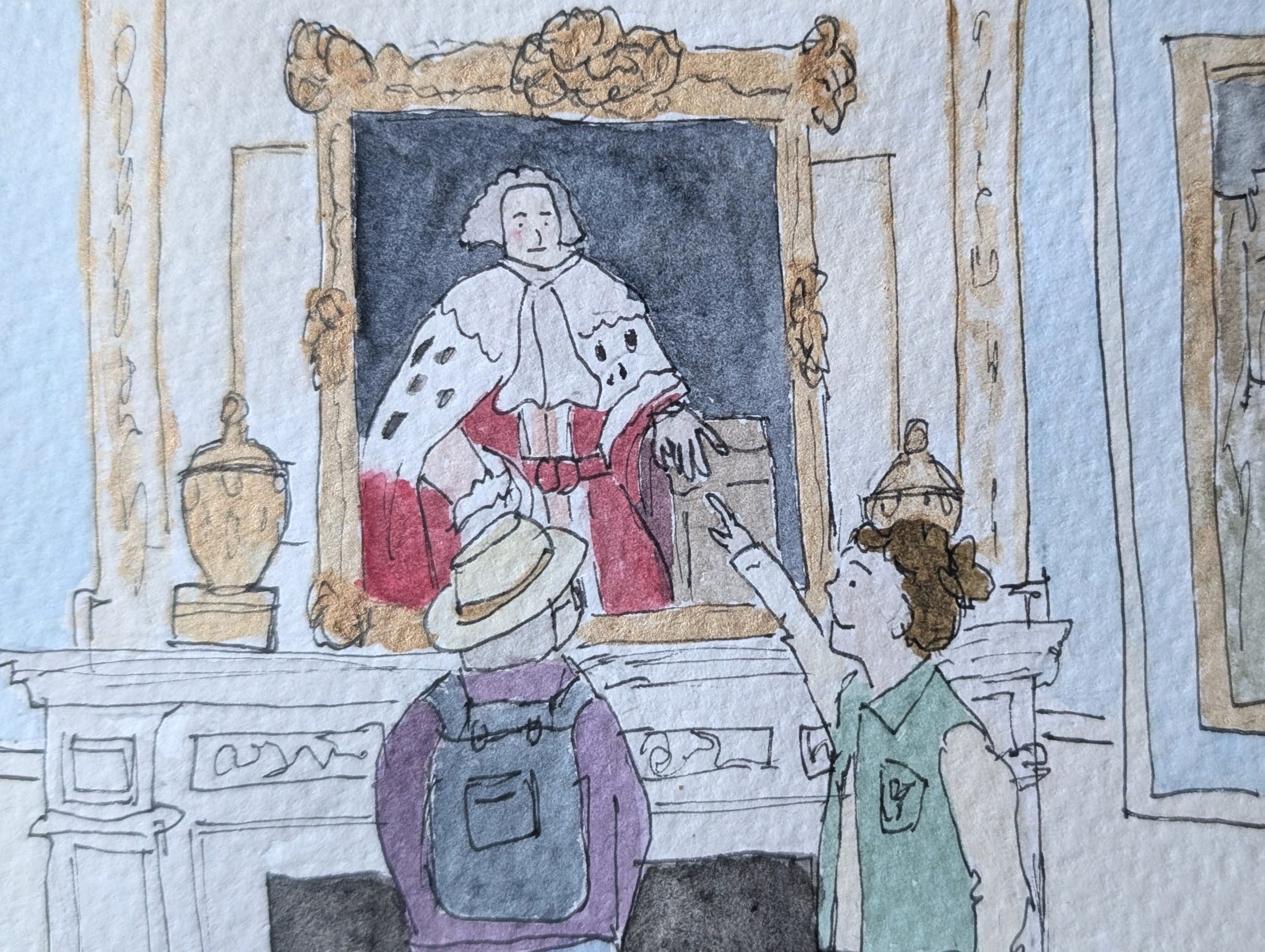
I looked again, and it was definitely odd. The proportions weren’t right, and the more I looked at it, the stranger it seemed. It almost looked as if the subject might have had an extra digit or a disability.
So, being me, I kicked off a conversation with the National Trust volunteer in the room.
She knew so many interesting things about the room, the objects, the painting and its history, but she’d never noticed that about the hand. As we chatted and looked together, it intrigued us both.
Suddenly we weren’t simply two people looking at a painting. We were curious together.
My small observation had opened up a conversation, and the conversation led to more questions.
I loved it.
I’ve had more thoughts about that hand since, because I can be horribly critical of my own artwork. I look at it and think, That’s not right. The perspective isn’t right. The colours haven’t come out right.
Oh gosh, and hands!
They are so hard to paint. How many times do I redo those? Even in my finished pictures I can find myself thinking, Oh well, I hope they don’t notice the hand.
Yet I can walk into a historic house, look at a painting created nearly 280 years ago and put its creator on a pedestal in an entirely different league, thinking, Wow. How amazing these artists were.
And, of course, they were. Their skill was extraordinary.
But apparently they could still paint a slightly dodgy hand.
I find that strangely encouraging.
There’s a difference between looking at something and thinking, That’s rubbish, and looking at it and thinking, That’s really interesting. I wonder what’s going on there?
The first is judgement.
The second is curiosity.
And I’m thinking I could do with a little more of the second, especially when I’m looking at my own work.
Brené Brown, who, if you come to my blog a lot, you’ll know I think is rather amazing, talks a lot about curiosity. She says it requires us to tolerate uncertainty and vulnerability. We have to be willing not to know.
She uses two phrases as a practice of curiosity that I think are absolutely great:
Tell me more.
I’m wondering...
I love these words because curiosity doesn’t demand that I have an answer. In fact, it begins with admitting that I don’t.
Brené talks about the difference between being a “knower” and being a learner. Sometimes being the knower can feel safer, because there’s vulnerability in saying, I don’t know, but I’d like to understand.
But I think that also brings so much freedom.
Curiosity followed me around on my holiday week.
As I walked through historic buildings and villages, I didn’t just want to know facts. I wanted to figure out what it would actually have been like to live there.
How dark would it have been in a room on a winter’s evening?
What would the smells have been like?
What would they have believed?
What would they have been frightened of?
What did an ordinary Tuesday look like for the person living here hundreds of years ago?
I found myself standing in ancient buildings, disappearing down rabbit holes about my own Christian faith, or wondering about a church and who built it. What did the people who came into those rooms believe? How have those ideas travelled and changed?
One question led to another question.
I wasn’t becoming an expert.
I just wanted to know.
And perhaps there’s something about historical curiosity that helps us grow in empathy. It’s easy to look backwards and judge people from another time with what we know now.
It takes imagination, though, to ask:
I wonder what the world looked like from where they were standing?
And then there was the sky.
That particular week there was a rather impressive solar eclipse. I could probably have looked at it, nodded wisely and pretended that I understood rather more astrophysics than I actually do.
But why?
It was so much more fun to wonder. To look. To ask questions. To admire other people’s photographs and marvel at what they’d been able to capture.
Maybe I understood a little more than I did before.
But I still don’t get it.
It’s incredible.
And that’s something I’m learning about curiosity.
I don’t have to understand something to be delighted by it.
I don’t have to master it.
I can simply pay attention.
Because curiosity makes room.
When I judge something, I reach a conclusion.
Well, that’s wrong.
That’s no good.
This is what I think.
I’m rubbish at that.
But curiosity puts a question mark where I might otherwise put a full stop.
That’s interesting.
I wonder why?
What am I missing?
How was that for you?
What might happen if I tried this differently?
And I’m thinking that the use of a small question mark creates room for other things to happen.
It creates room for learning, growth, empathy, connection and, importantly, fun.
Because that National Trust volunteer and I weren’t having a fascinating conversation because either of us had all the answers.
She knew things I didn’t know.
I’d noticed something she hadn’t noticed.
And between us there was a slightly odd hand on a nearly 280-year-old painting that gave two strangers something to investigate together.
I want more of this.
More of really looking.
More of noticing.
More conversations where I’m less interested in proving what I know and more interested in discovering what I don’t.
More generosity towards the bits of my own work, and perhaps the bits of myself, that aren’t quite how I think they should be.
More willingness to say:
That’s interesting. I wonder...
Because perhaps curiosity doesn’t just help us understand the world.
Perhaps it helps us connect with it.
And with each other.
Love that idea. It's so easy to judge when we interact with people in our day and age and in our culture - much harder to step back and be curious. But when we are curious we find commonality and perhaps find where we don't have things right, or at least be open to a different opinion.