

On Friday, my son called me. He was on his way home from the Big Church Festival and rang to let me know he was okay. He was worried that I would see news reports of a terrible incident and be frightened for him.
I was so grateful for his care and concern for me, but mostly I was just relieved.
My son was okay.
Later that evening, I realised that a falling sign had taken the life of a man who was a husband and a father, and two others were critically injured.
I felt such a confused mix of emotions. There was enormous relief that my son was all right, alongside this awful knowledge that while I’d had a phone call telling me my son was safe, another family was facing devastating news.
At the same time, I was seeing news from the other side of the world of devastating floods that had killed hundreds.
I just found myself thinking: this is hideous. These people matter. This shouldn’t be happening.
I have this deep sense of the preciousness of human life. For me, it comes from believing that we are created by God and that every one of us carries his image. Every person matters.
And as I was thinking about all of this, my mind went back 16 years to the earthquake in Haiti.
My sons were four at the time. I was watching the distressing images on television with one of them, seeing the devastation and the appeals for money, and trying somehow to explain to my little boy what had happened.
He disappeared upstairs.
A little while later he came back carrying his piggy bank.
“Mum, I want you to take all of this money to the post office for those children who don’t have anything now.”
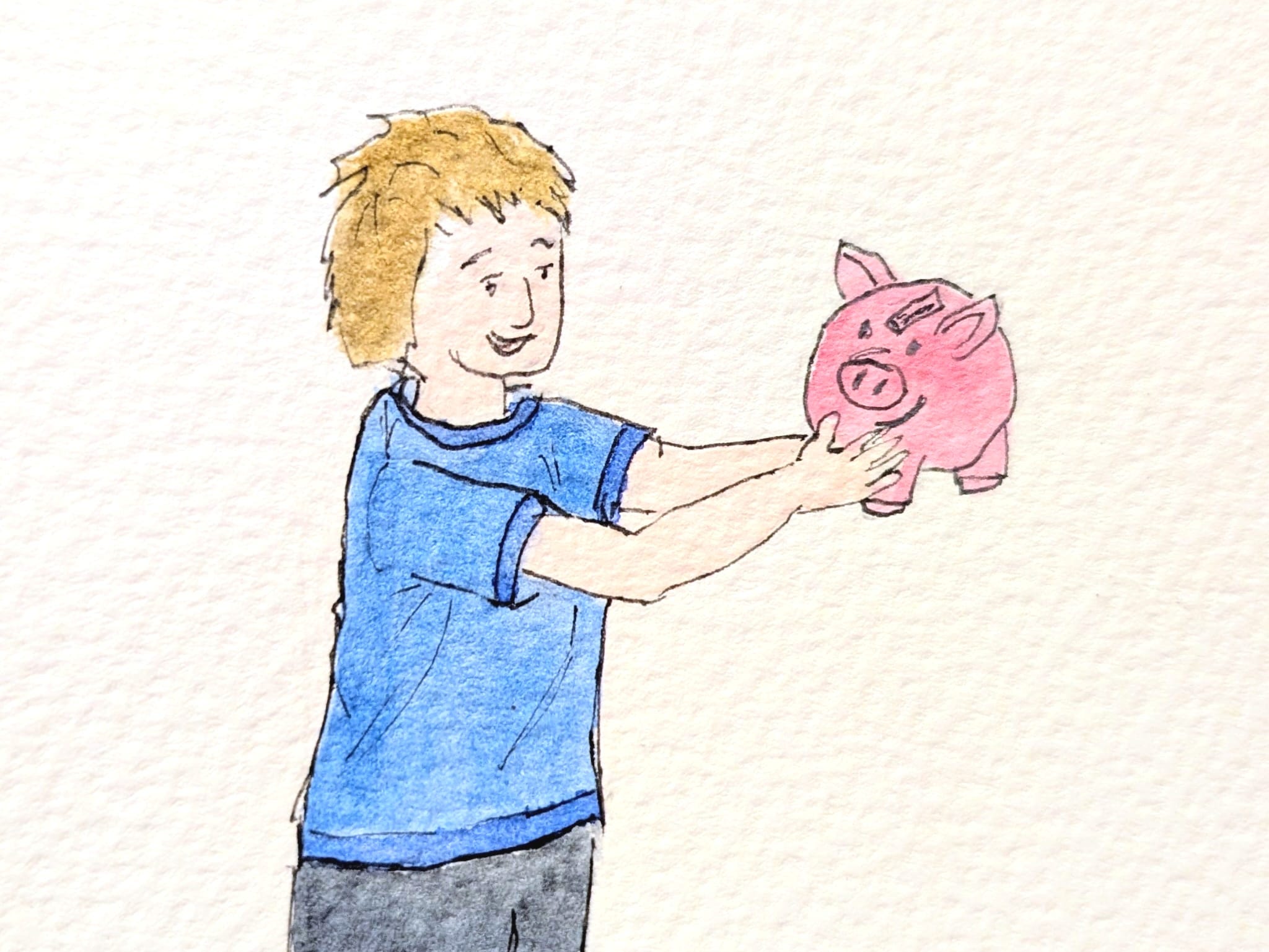
And my response wasn’t to tell him that the contents of a four-year-old’s piggy bank weren’t going to make much difference. I didn’t tell him that terrible things happen all over the world and we can’t possibly help everyone.
Of course I would help him give it.
I was just incredibly moved by my little boy. There he was, too young for theology, just living out the image of a generous God.
He saw suffering and his instinct was compassion.
And here is the bit I’ve only really understood recently in my own healing from trauma.
The compassion I instinctively feel when somebody else is suffering applies to me too.
I’ve been able, increasingly, to look at myself and say:
I matter.
What happened to me mattered.
My pain matters.
It sounds like such a small step.
For me, it has been a huge journey.
And even as I write that, I can hear myself doing it. “Other people had it worse. My suffering wasn’t that bad”.
But I’m not talking about scale.
I’m talking about the simple reality that people matter.
And that includes me.
I think sometimes, when we look at our own suffering, we say things like:
Other people have it much worse.
I mustn’t make a fuss.
I’ll find something to be grateful for.
Surely I can forgive and move on.
But when we do that, I think we bypass something essential.
Before we can heal, we have to be able to say:
This hurt.
This mattered.
I mattered.
I needed safety.
I’m allowed to grieve what happened.
This makes me think of the work of psychiatrist and trauma researcher Judith Herman. She describes three broad stages of recovery: establishing safety, remembrance and mourning, and reconnection.
This fits so much with what I’ve been discovering for myself.
I had been trying to leap straight to reconnection.
I wanted to understand, process, forgive, make sense of things, behave well and make things better.
But first I needed to ask: Am I safe? How can I begin to feel safe?
Because creating safety says something important.
I am worth protecting.
And mourning says something too.
What happened to me is worth grieving.
Which brings me back to lament, something I’ve written about before.
I think lament is deeply human and deeply spiritual. It isn’t wallowing, and it isn’t saying that there is no hope. It is refusing to deny the reality and intensity of pain in our rush to get somewhere better.
And after all this thinking, I still find myself asking, “Why, God?”
And sometimes, “Where were you?”
I can ask those questions about what I see happening in the world. And I can ask them about my own story too.
I’ve come to believe my faith doesn’t require me to suppress those questions. That’s part of lament too.
So this blog post doesn’t end with an answer to suffering.
I don’t have one.
But perhaps I don’t need an answer to suffering before I can choose how I respond.
When somebody far away is suffering, I can notice and care. I can pray, and I can give.
When it’s my friend beside me, I can listen. I can protect, and I can help.
And when the person suffering is me?
I think it’s the same.
I can notice.
I can listen.
I can believe that it matters.
I can seek safety.
I can respond to myself with compassion.
My little boy didn’t try to work out whether those people in Haiti had suffered enough to deserve his compassion. He didn’t compare their pain with somebody else’s. He didn’t calculate whether the contents of his piggy bank could fix anything.
He simply saw suffering and responded with compassion.
Sixteen years later, I think I’m learning to respond to myself a little more like my four-year-old.
He saw suffering and responded with compassion.
It’s not because I’ve suffered more than somebody else or because I can prove that what happened was bad enough.
But because I’m human.
My life is precious.
I’m worth protecting.
And my suffering matters.
And I hope you can see for yourself that you matter too.