

Following on from last week’s reflections on self-compassion and forgiveness, I’ve found myself continuing to think about forgiveness this week.
Or perhaps more accurately, musing about it.
My thinking has been prompted in part by continuing to read Forgiveness by Amy Orr-Ewing. Her writing has given me a lot to sit with, particularly around how forgiveness works in practice, and what it is and what it isn’t.
Forgiveness sounds relatively simple in theory.
In real life, it feels much more complicated.
I’m still learning that forgiveness isn’t forgetting. It isn’t pretending. It isn’t saying, “It didn’t hurt,” or “It didn’t matter.”
If anything, I’m beginning to realise that forgiveness starts with truth-telling.
Telling the truth about what happened.
And telling the truth about what it cost.
One of the images I keep coming back to is debt.
Perhaps that’s because one of the original ideas behind forgiveness is the forgiving of a debt. Someone owes you something, and you choose to release them from what they owe.
When we’re hurt, something is taken from us.
Sometimes it’s something tangible. More often it’s something harder to put into words. Trust. Safety. Time. Hope. Confidence. Peace.
Whatever it is, something precious has been lost.
And loss creates a debt.
As I’ve been mulling this over, I’ve found myself wondering whether sometimes we try to forgive before we’ve honestly reckoned with the size of that debt.
It’s as though someone owes us £1,000, but we’ve quietly written £5 in the ledger instead.
Perhaps because that feels easier.
Perhaps because naming the true cost would mean sitting with grief, anger or disappointment that we’d rather avoid.
We tell ourselves it wasn’t that bad.
They didn’t mean it.
Other people have had it worse.
Maybe.
But you can’t release what you’ve never fully named.
Forgiveness doesn’t begin by pretending the wound is small.
It begins by telling the whole truth about the cost.
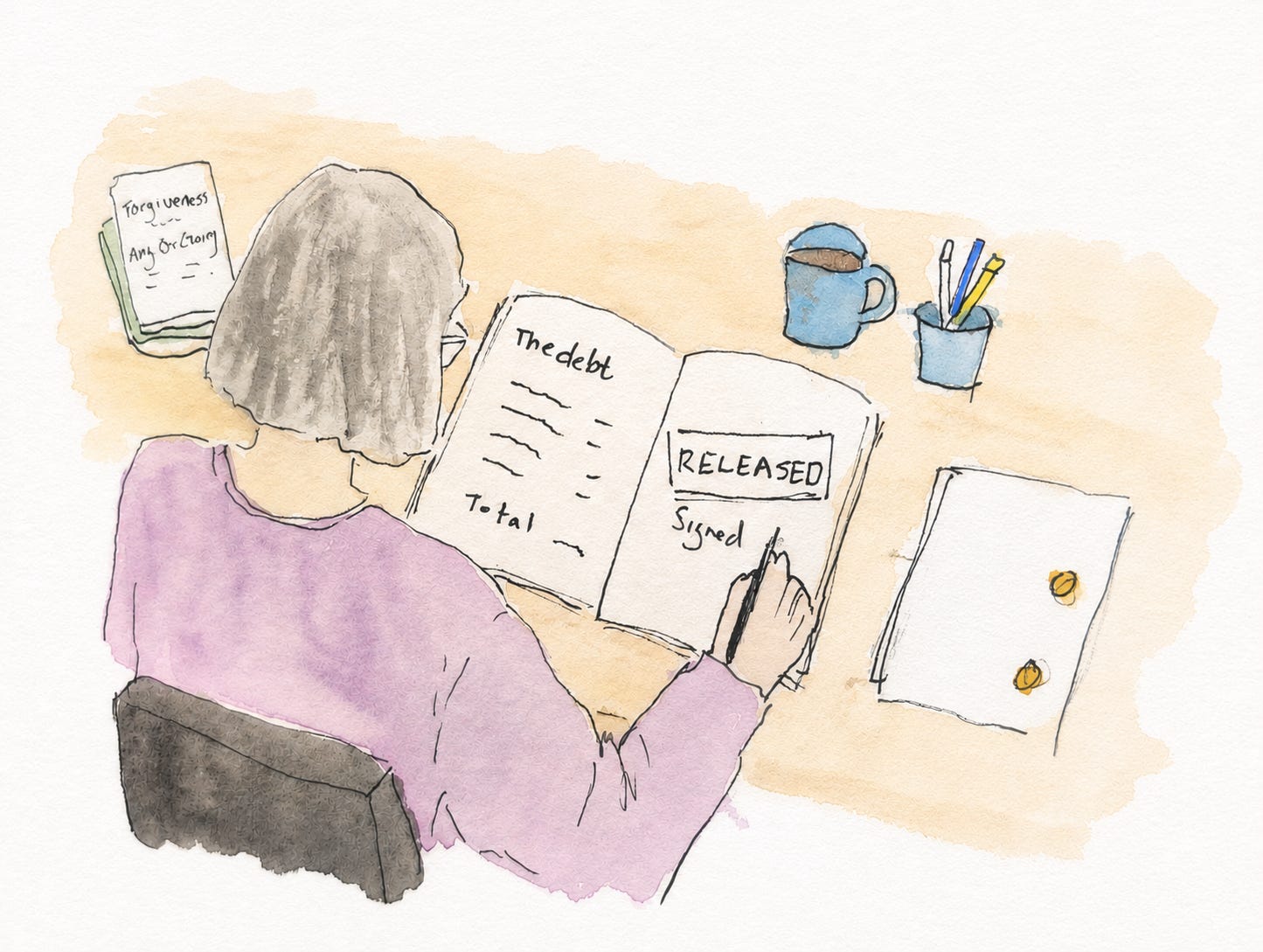
As I was reading Amy Orr-Ewing’s book, one particular illustration really stayed with me.
She describes the process of buying a house. The buyer transfers the money and, from their perspective, their part is complete. The funds have left their account. They have released them.
But the money doesn’t immediately pass into the seller's hands.
Instead, it is held safely by the solicitor until the agreed conditions have been met and completion takes place.
I found that metaphor surprisingly helpful.
Because I think forgiveness works something like that.
There comes a point where we release the debt.
In the analogy, we’ve already sent the funds.
We say, “I am no longer holding this debt in my hands. I am giving up my right to revenge. I am releasing my demand to be repaid.”
In that sense, our part is done.
But that doesn’t necessarily mean everything is immediately restored between the person who hurt us and us.
From a faith perspective, I find myself imagining that when I release the debt, I entrust it to God.
He’s rather like a heavenly solicitor.
It’s no longer mine to grip tightly.
But neither is it mine to decide what happens next.
It’s held safely.
And what follows may depend on what happens on the other side. Whether there is sorrow. Repentance. Honesty. Repair. Change.
That distinction feels important to me.
Forgiveness can be real and wholehearted while still acknowledging that something significant happened.
I’ve released the debt.
But that doesn’t automatically mean everything goes back to how it was before.
In fact, one of the things I’ve been noticing is that releasing the debt may be as much about what happens within me as what happens between us.
Anger, as I’ve written about before, isn’t wrong.
Often, anger is the thing that helps us recognise that something mattered.
That a boundary was crossed.
That a loss occurred.
That a debt exists.
Anger can help us tell the truth.
But carrying anger for a long time is heavy work.
The mind circles around it.
The body holds it.
The nervous system braces around it.
And forgiveness, when it comes, isn’t about excusing someone or pretending the harm didn’t happen.
It’s about setting down a weight we were never meant to carry forever.
Not because it didn’t matter.
Because it did.
Not because the debt wasn’t real.
Because it was.
Not because the wound wasn’t costly.
Because it was.
These are things I’m continuing to mull over.
And I’m increasingly aware that forgiveness doesn’t necessarily mean reconciliation.
Nor does it automatically lead to restored trust.
Those things are connected, but they are not the same.
Trust often needs rebuilding.
Relationships often need repair.
And reconciliation may or may not ultimately be possible.
That feels like another musing entirely, and perhaps one I’ll come back to another time.
For now, I’m sitting with this:
Forgiveness doesn’t ask us to pretend the wound was small.
It asks us to tell the truth about what it cost.
And then, slowly and carefully, we work towards releasing that debt from our hands.