

I have a slightly awkward confession to begin with.
Over the past six weeks, I’ve eaten my feelings.
Quite enthusiastically.
And this has been particularly disheartening because, in the eighteen months leading up to the start of this year, I worked really hard to care for my body. I moved more. I ate more thoughtfully. I lost a significant amount of weight. I felt steadier, stronger, more at home in myself. It wasn’t effortless, but it felt earned.
Then pressure mounted. Old trauma stirred. Buried things resurfaced.
And my nervous system reached for the coping strategy it knows best.
Food.
If you’ve ever felt that familiar “What’s the point?” spiral start to whisper, the quiet shame, the sense of having undone something important, you’ll know how heavy that moment can feel.
Almost exactly a year ago, I wrote a piece called Learning to Need. It came from a realisation in therapy that I had been living as though my only needs were food, water, and shelter. Survival basics. If I had a roof over my head and something to eat, I assumed I was fine.
I was not fine.
That blog was about discovering that self-care wasn’t indulgence, it was a necessity. It was about allowing myself to need more than survival.
Apparently, this year is the sequel.
When the Body Is Doing Its Best
One of the biggest shifts for me recently has been understanding what’s happening under the surface.
When old trauma is stirred, it isn’t just emotional, it’s neurological. The brain’s threat system activates, the nervous system shifts into survival mode, and the body begins seeking regulation.
Food is very good at that.
Eating stimulates dopamine, dampens cortisol, and offers immediate comfort. From a nervous system perspective, emotional eating isn’t a moral failure; it’s an attempt to self-soothe.
Or, as I’m learning to say with more kindness:
My body wasn’t sabotaging me; it was trying to help.
Writers like Bessel van der Kolk and Gabor Maté have written extensively about this, how the body holds stress and trauma, and how our coping behaviours often make perfect sense when you understand the context they arise from.
Shame melts when curiosity steps in.
Compassion Is Not the Same as Letting Yourself Slide
At the same time as all this was unfolding, I was reading more about self-compassion, particularly the work of Dr Kristin Neff, who is very clear that compassion isn’t the same thing as indulgence.
And this is where it got interesting.
Because self-care isn’t always soft.
It isn’t always candles and warm baths and early nights.
Sometimes self-care is discipline.
Sometimes it’s structure.
Sometimes it’s choosing the thing that will help, even when you don’t feel like it.
I decided to treat myself, not as a reward, and not as a punishment, but as support. I bought myself a new smartwatch and paired it with an app. Not to whip myself into shape, but to gently anchor myself again.
I started eating a bit better.
I began walking regularly, often with Barney (my fabulous Collie), out into the countryside.
Fresh air. Movement. Space.
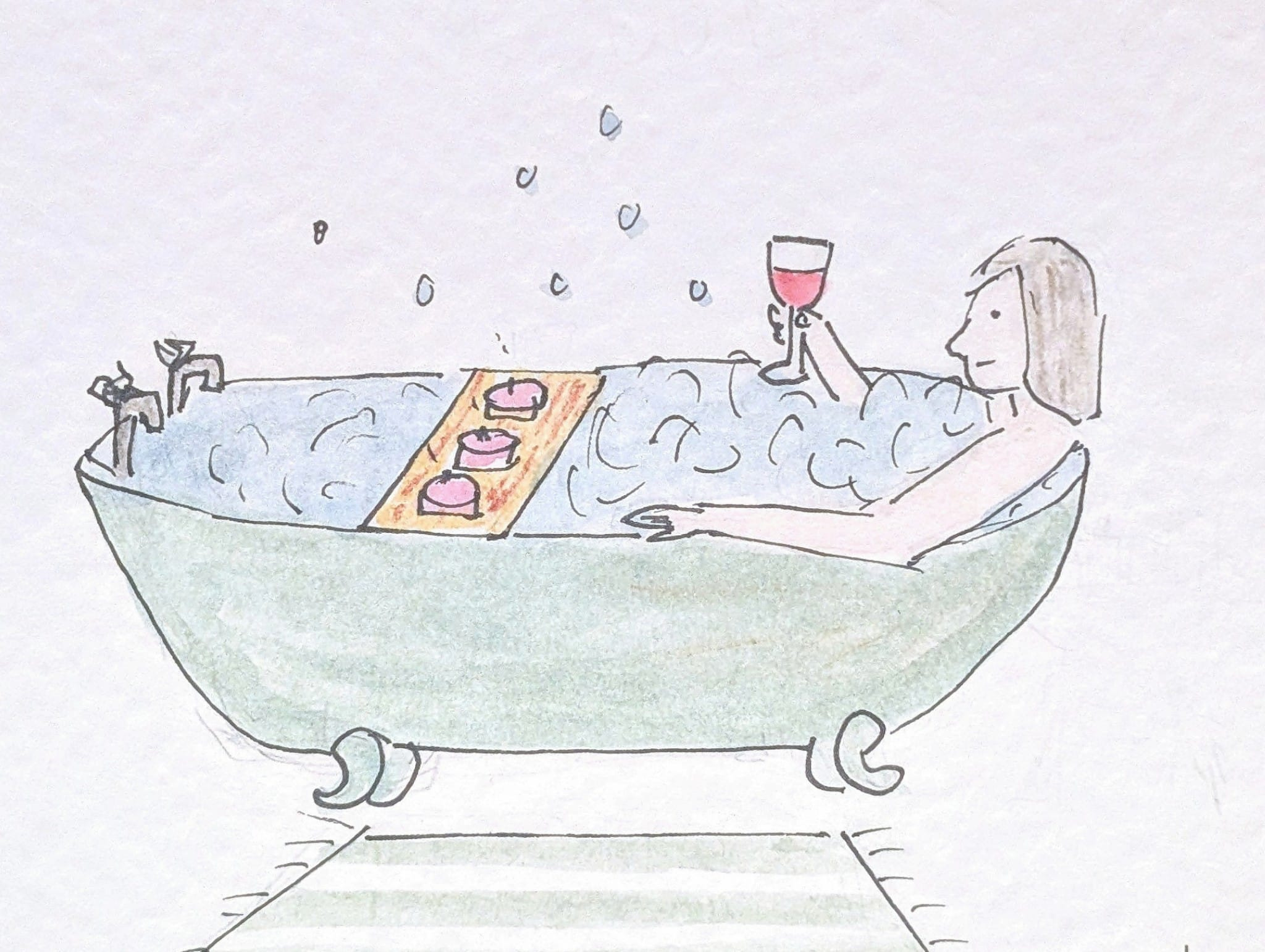
This image used to sum up what I thought self-care was.
And sometimes it is.
But it isn’t the whole picture.
Walking, Regulation, and Muddy Boots
There’s something quietly powerful about walking.
The rhythmic, alternating movement provides bilateral stimulation, the same principle used in trauma therapies like EMDR. Add daylight, fresh air, and a stretch of open landscape, and you have a nervous system gently being reminded that it’s safe.
That academic information wasn’t in my mind when I started walking again.
But my body knew.
And I loved that this kind of care wasn’t glamorous.
Dirty boots. Cold air. Sometimes a bit of grumbling.
But it worked.
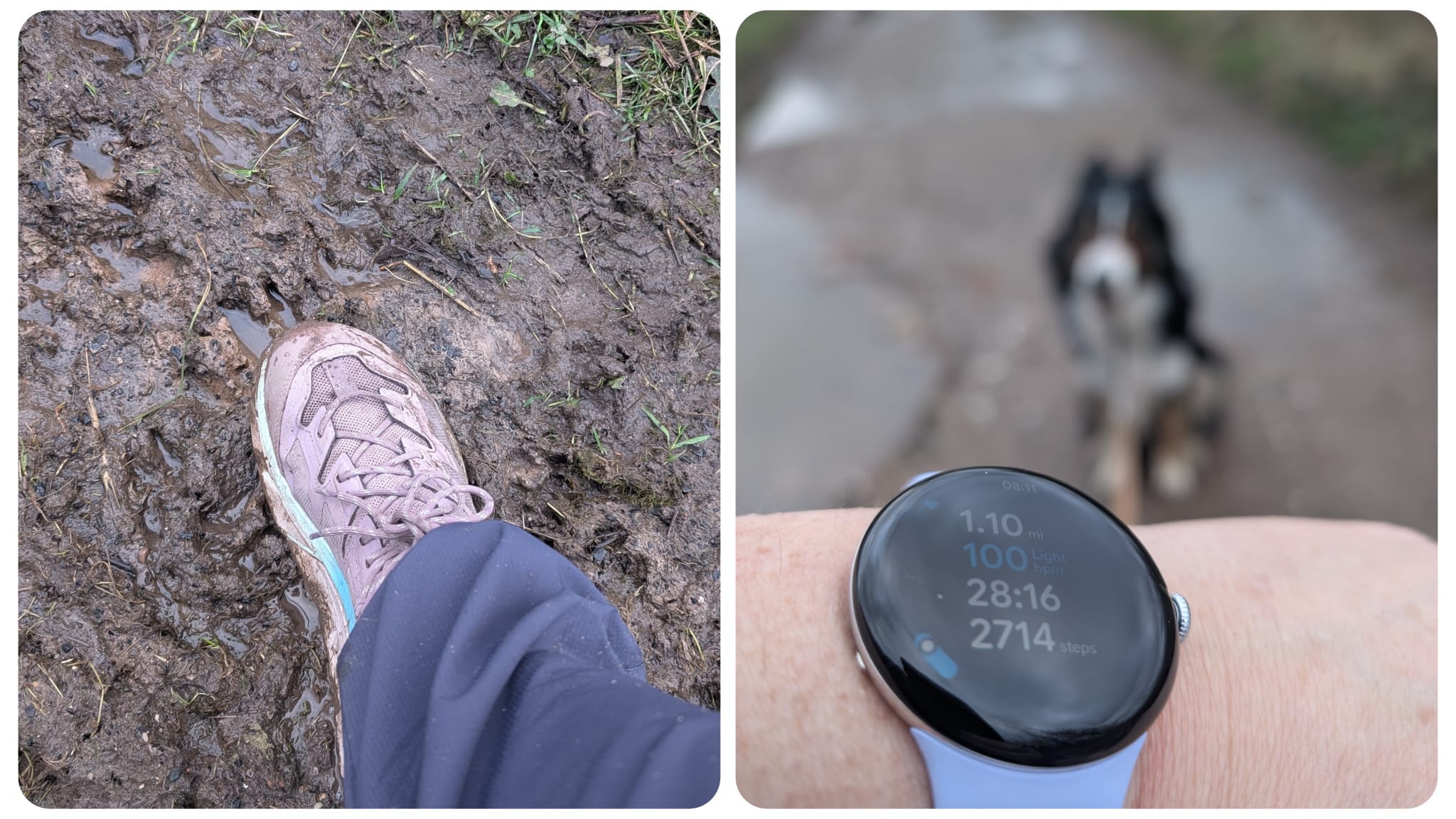
Self-care isn’t always soft.
The Migraine Moment
Then a few nights ago, a migraine hit.
The kind that ruins your sleep, leaves your neck, face and head throbbing, and makes even a short walk feel wildly optimistic. I had been awake for hours in the night, and I woke in pain and immediately felt that old internal voice warming up:
You can’t do this. What’s the point? You might as well just eat.
This was the moment I usually disappear into old patterns.
But something shifted.
I spoke into the app. I said what I couldn’t do. I named the difficulty instead of bulldozing through it. And back came a response that essentially said, "That’s a tough start." Be kind to yourself.
I cannot overstate how proud I felt.
Not because I felt great, I didn’t, but because I didn’t abandon myself. I didn’t spiral. I didn’t turn one disrupted night into a story about failure.
I rested.
I got through the morning.
And later that afternoon, when the pain eased (and after a bubble bath!), I went out for my walk anyway.
And it helped. Deeply.
The Hard Edge of Self-Care
This is what I’m learning now.
Real self-care isn’t indulgent.
It’s the steady, sometimes uncomfortable practice of responding to yourself with both kindness and courage.
Sometimes self-care is a bath.
Sometimes it’s lacing up your hiking boots with a migraine hangover.
Sometimes it’s not eating the feelings.
Sometimes it’s eating them and forgiving yourself.
It’s showing up.
It’s keeping small promises.
It’s being kind without letting that kindness turn into collapse.
Growth, I’m discovering, isn’t never slipping back into old patterns.
It’s noticing sooner.
Recovering faster.
Choosing differently, not always, but more often.
It isn’t perfection.
It’s practice.
And for now, that feels like real care.
If this piece resonated, you might like to read the post that came before it.
Almost exactly a year ago, I wrote Learning to Need — a reflection on discovering that self-care isn’t indulgence, but necessity. At the time, I was just beginning to realise that being “fine” on paper isn’t the same as being well.
You could think of that piece as Part One.
This feels very much like Part Two.
You can read Learning to Need: A Journey to Real Self-Care:
👉 here
And if you’d like to receive future illustrated reflections straight to your inbox, you’re very welcome to subscribe to Illustrated Musings. No pressure, just gentle company on the journey.